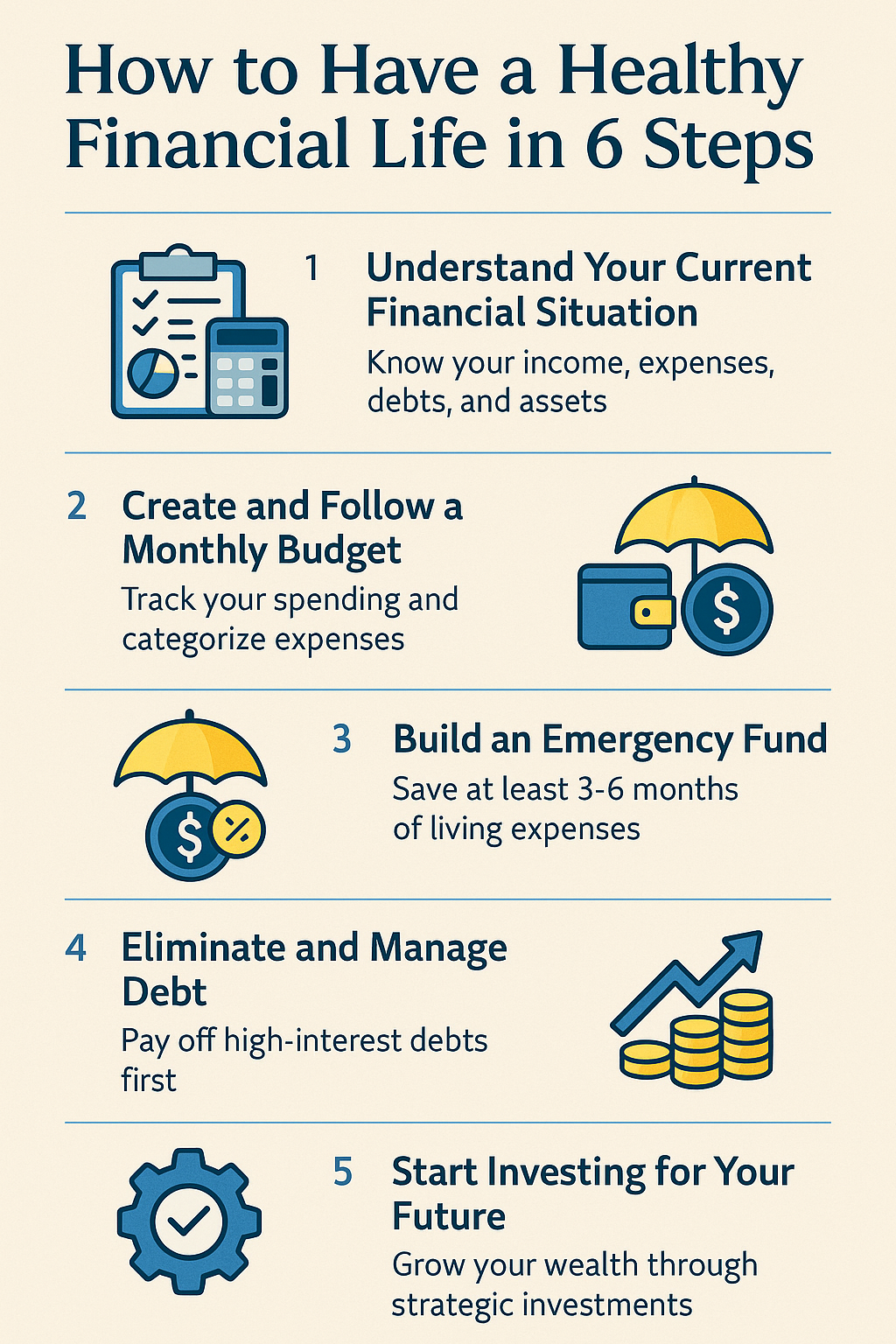
Achieving a healthy financial life is not about being rich — it’s about building habits that support security, peace of mind, and long-term freedom. A healthy financial life allows you to manage your money with confidence, handle emergencies without stress, and plan for the future without fear.
The good news is that anyone can reach financial wellness, regardless of income level or past mistakes. In this comprehensive guide, you’ll learn the six essential steps to develop strong financial health and maintain it for life.
Step 1: Understand Your Current Financial Situation
The first step toward financial health is self-awareness. Just like a doctor needs to diagnose before prescribing treatment, you need a clear picture of where you stand financially before making any decisions.
Take Inventory
Start by writing down:
- Your total monthly income (after taxes)
- Your total monthly expenses
- Your current debts (credit cards, loans, etc.)
- Your savings balance
- Your assets (car, property, investments)
Having all your numbers in one place, even if they’re not where you want them to be, is empowering. It gives you a realistic starting point.
Analyze the Gap
If your expenses are higher than your income, you’re either accumulating debt or using savings to cover the difference. That’s unsustainable. Knowing this helps you identify where change is needed.
Step 2: Create and Follow a Monthly Budget
A budget is not about limiting your freedom. It’s a roadmap that tells your money where to go, instead of wondering where it went.
Build a Simple Budget
Use a method that suits you — spreadsheet, notebook, or app — and include:
- Fixed expenses (rent, utilities, subscriptions)
- Variable expenses (groceries, gas, shopping)
- Financial goals (savings, investments, debt repayment)
One of the most popular methods for beginners is the 50/30/20 rule:
- 50% for needs (housing, utilities, food)
- 30% for wants (entertainment, shopping, dining out)
- 20% for savings and debt repayment
Stick to It
Set a weekly check-in to review your progress and make adjustments. A budget only works if you consistently use it.
Use Technology to Help
Apps like YNAB, Mint, or EveryDollar can simplify budgeting and help track spending in real-time.
Step 3: Build an Emergency Fund
Financial emergencies are not a matter of if — they’re a matter of when. Whether it’s a job loss, unexpected medical bill, or a broken appliance, having a safety net can prevent stress and debt.
Start Small
If you’re starting from zero, aim to save $500 to $1,000 as quickly as possible.
Grow Gradually
Eventually, your emergency fund should cover three to six months of essential living expenses. This gives you room to breathe during tough times without turning to credit cards or loans.
Where to Keep It
Use a separate high-yield savings account. This ensures accessibility while reducing the temptation to dip into it for non-emergencies.
Step 4: Eliminate and Manage Debt
Debt is one of the biggest obstacles to financial wellness. Not all debt is bad (for example, a low-interest mortgage), but consumer debt — like credit cards — can drain your finances and your peace of mind.
List All Your Debts
Include:
- Balance owed
- Minimum monthly payment
- Interest rate
This gives you a clear picture of what you’re up against.
Choose a Payoff Strategy
Two common methods:
- Debt Snowball: Focus on paying off the smallest debt first. Great for motivation.
- Debt Avalanche: Focus on the debt with the highest interest rate. Best for saving money long-term.
Avoid New Debt
While paying off current debt, avoid taking on new loans or using credit cards for non-essential spending. Create a cash-only rule if needed.
Step 5: Start Investing for Your Future
Once you’ve built an emergency fund and are managing debt, it’s time to think long-term. Investing is not just for the wealthy — it’s how average people build wealth over time.
Start Early, Even with Small Amounts
Thanks to compound interest, the sooner you start investing, the more your money grows.
Even $50 to $100 per month can turn into tens of thousands over decades.
Understand Your Options
Basic investment tools for beginners:
- Index funds and ETFs: Low-cost and diversified
- Retirement accounts: 401(k), IRA, or Roth IRA
- Robo-advisors: Automatically manage your investments
Set Clear Goals
Ask yourself:
- When do I want to retire?
- Do I want to buy a home?
- Am I saving for my children’s education?
Let your goals shape your investment strategy.
Step 6: Maintain and Improve Financial Habits
A healthy financial life is not a one-time achievement — it’s a lifelong commitment. As your income grows, or your life changes, so will your financial needs.
Practice Mindful Spending
Before making any purchase, ask:
- Do I really need this?
- Can I afford it without debt?
- Is this aligned with my values and goals?
Impulse spending is one of the fastest ways to sabotage financial progress. Mindful spending creates more satisfaction and less guilt.
Review Regularly
Every month, review:
- Your budget
- Your savings and debt progress
- Your upcoming expenses
Quarterly or annually, assess your long-term goals and make adjustments.
Continue Learning
The world of personal finance is always evolving. Read books, listen to podcasts, and follow financial educators who align with your values.
Great resources include:
- The Total Money Makeover by Dave Ramsey
- The Simple Path to Wealth by JL Collins
- Your Money or Your Life by Vicki Robin
Signs of a Healthy Financial Life
- You spend less than you earn
- You pay your bills on time and in full
- You have money set aside for emergencies
- You have a plan to get out of debt
- You are saving and investing for the future
- You feel in control, not anxious, about your finances
If you’re not there yet, don’t worry — these habits are built over time, one step at a time.
Final Thoughts: Financial Health Is Self-Care
Caring for your finances is one of the most impactful forms of self-care. It affects your stress levels, your relationships, and your future possibilities. And just like eating healthy or exercising, it starts with small, consistent choices.
Begin with just one step from this guide — maybe it’s tracking your expenses this week, or starting a $10 savings habit. Then, build from there. With every intentional decision, you move closer to a financial life that is stable, secure, and fulfilling.
You don’t have to be perfect. You just have to start — and keep going.